


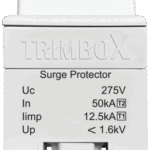
Definition of Surge Protective Devices (SPD), Surge Suppression Devices (SSD), and Neutral-Ground Regulators (NGR)
When examining global statistics, it appears that electricity is the primary cause of a significant 25-40% of fires. Excluding factors such as forest fires and sabotage, electrical faults account for an alarming 60-80% of structural fires.
The main reason for this high rate is that, for many years, electrical regulations have defined “overvoltage protection” exclusively through Surge Protective Devices (SPDs). However, contrary to common belief, when the technology and test terminology of SPDs are examined, it becomes clear that they do not directly suppress overvoltage; instead, they focus on discharging the surge current caused by overvoltage to the ground. This makes them a limited method for preventing voltage surges from damaging devices.
Surge Suppression Devices (SSD)
In addition to SPDs, Surge Suppression Devices (SSD) offer protection without requiring a high-quality grounding system — and even function effectively in the absence of grounding (since an SPD becomes completely ineffective without proper grounding). SSDs suppress overvoltages between phase-phase and phase-neutral lines at their source, either by dissipating the surge or cutting off power to eliminate potential damage or fire risk before it begins.
Neutral-Ground Regulators (NGR)
Neutral-Ground Regulators (NGR) stabilize the potential difference between neutral and ground to below 1 volt — and prevent it from fluctuating more than 0.2 volts. This ensures system stability, particularly in high-tech environments. By eliminating critical safety risks (such as fire alarm systems going offline when the neutral-ground voltage exceeds 1V), and with their built-in surge suppression circuits, NGRs set a new standard in electrical safety.
Surge Protective Device (SPD): What It Is — and What It Is Not
Surge Protective Devices (SPD) are designed to discharge excess current to ground when overvoltage occurs. In other words, they do not suppress voltage — they only divert the current resulting from it.
In pricing catalogs, phrases like “Protection against overvoltage and neutral protection” are often listed next to SPD items. However, these phrases are not official claims of any SPD manufacturer worldwide; they are typically translation errors or marketing additions by importers to make the product sound more capable than it actually is.
As a result, engineers, contractors, and electricians who select SPDs believing they provide neutral or overvoltage protection may unknowingly leave their systems unprotected.
In conclusion, SPDs do not protect against neutral disconnection faults or overvoltage. Moreover, if grounding is weak or faulty, SPDs cannot even perform their discharge function.
Surge Suppression Device (SSD): The Next Generation of Effective Protection
A Surge Suppression Device (SSD) goes far beyond a conventional SPD. When an overvoltage occurs, it doesn’t merely redirect current — it actively suppresses it. This enables SSDs to maintain neutral-line balance and protection even during neutral faults. They operate effectively even with insufficient grounding, balancing the voltage difference between phase, neutral, and ground within nanoseconds — preventing faults before they occur.
Trimbox’s TRVaristor technology delivers up to 50 times the strength of traditional varistors, protecting electronic boards, PLC systems, and preventing micro-arcs that could cause fires. SSDs ensure full system integrity — precisely where SPDs fall short.
Neutral-Ground Regulator (NGR): Regulating the Invisible Risk
One of the most overlooked risks in electrical installations is the neutral-to-ground potential difference. Weak, loose, or disconnected neutrals can lead to unstable voltages, leakage currents, and overheating that may cause fires.
Neutral-Ground Regulators (NGR) continuously monitor this potential difference and instantly regulate it if it exceeds 1 volt — eliminating fire hazards and preventing electronic equipment failure.
NGRs are crucial for environments requiring continuous operation, such as emergency lighting, alarm systems, fire detection systems, hospitals, and data centers.
Technical Comparison of the Three Devices
| Feature | Surge Protective Device (SPD) | Surge Suppression Device (SSD) | Neutral-Ground Regulator (NGR) |
|---|---|---|---|
| Protection principle | Discharges excess current to ground | Actively suppresses overvoltage | Monitors and regulates neutral-ground difference |
| Grounding requirement | Mandatory | Operates even with poor or no grounding | Stabilizes difference even with weak grounding |
| Neutral line protection | None | Provides active protection | Continuously regulates neutral-ground balance |
| Response time | Nanoseconds | Nanoseconds | Continuous monitoring/regulation |
| Standards | IEC 61643-11, UL 1449 | IEC 61643-11, UL 1449, TSEK | IEC 61010-1, IEC 60950, TSEK |
A New Chapter in Electrical Regulations
Currently, the Turkish Electrical Internal Installations Regulation refers to overvoltage protection only under the “SPD” category. However, SSD and NGR should be technically defined under separate headings.
Trimbox has submitted a proposal to TSE, the Ministry of Environment and Urbanization, and local Governorates, recommending that the mandatory use and inspection of SSDs — for energy continuity and fire safety — be explicitly included in both the internal installation and fire safety regulations.
Turkey Writes Its Own Standard
By implementing these updates, Turkey will take a pioneering step toward creating its own technical standard in electrical safety.
This IEC–UL–TSEK-compliant model will support local manufacturing in six countries across four continents, including the United States, while providing technical superiority in exports.
With 18 years of R&D experience and its Test & Innovation Center, Trimbox leads this transformation.
Its locally developed TRVaristor-based SSD and NGR devices redefine “pre-fire protection,” introducing a new understanding:
“Not just protection devices — but preventive technologies.”
Conclusion: Updating the Regulation Means Fewer Fires
Defining SPD, SSD, and NGR as separate classes in the revised Electrical Internal Installations Regulation will ensure correct device selection, continuous power supply, and improved safety for people and facilities — while reducing fire incidents caused by electrical faults.
Electrical safety is no longer just about grounding; it is a holistic concept that includes neutral-ground balance, overvoltage suppression, and active regulation.
Incorporating this holistic approach into regulations is both an engineering and a moral responsibility — for the future of Turkey.